Quick answer: how should siblings’ Name Slips be organized?
Use separate personalized Name Slips for belongings that clearly belong to one child.
Keep truly shared family items separate from child-specific school identification.
When an item moves from one sibling to another, treat that as a change of ownership and update the visible label.
At the start of each school year, recheck:
- class,
- section,
- roll number,
- school,
- subject,
- photo,
- theme,
- child name format.
For Dimple specifically, the current Name Slip sheet is designed for:
one child + one selected details/theme set per sheet.
On this page
- Quick answer: how should siblings’ Name Slips be organized?
- The sibling system at a glance
- 1. CHILD-SPECIFIC — keep ownership unmistakable
- Why surname alone is usually not enough for siblings
- What if both siblings attend the same school?
- What if the siblings are in the same class?
- What if the siblings have similar names?
- 2. SHARED — do not pretend a shared item belongs to one child
- Shared at home does not always mean shared at school
- Should siblings share one Name Slip sheet?
- Can siblings choose the same theme?
- Is it better to use different themes for siblings?
- Can siblings use the same child photo?
- 3. HAND-ME-DOWN — ownership changed, so identity must change too
- What should you do with an old sibling label?
- Can I place a new label over the old sibling’s label?
- What about textbooks passed from an older sibling?
- What about hand-me-down notebooks?
- 4. UPDATE — siblings multiply the number of changing details
- The sibling annual audit
- A simple sibling sorting system
- Why an “uncertain” pile is useful
- Should siblings use different colors?
- Should twins use different label designs?
- Should siblings in the same school use the same format?
- Should siblings in different schools use different formats?
- What if one child needs a photo and another does not?
- What if siblings have different privacy needs?
- Siblings and subject labels
- Siblings and long names
- What about leftover Name Slips from one sibling?
- What if both siblings have the same first initial?
- What if siblings share the same bag or storage bin?
- What if siblings swap pencil boxes?
- What if the sibling is in preschool/daycare?
- One family, one system — but not one label
- The Dimple sibling framework
- A practical 15-minute sibling Name Slip setup
- 8 common sibling labeling mistakes
- A sibling order-preparation checklist
- What if both children want the same Dimple theme?
- What if one child changes schools mid-year?
- What if a younger sibling inherits almost everything?
- What if two siblings have identical notebooks?
- What if only one child needs labels right now?
- Before you approve
CLASS 1A
CLASS 3B
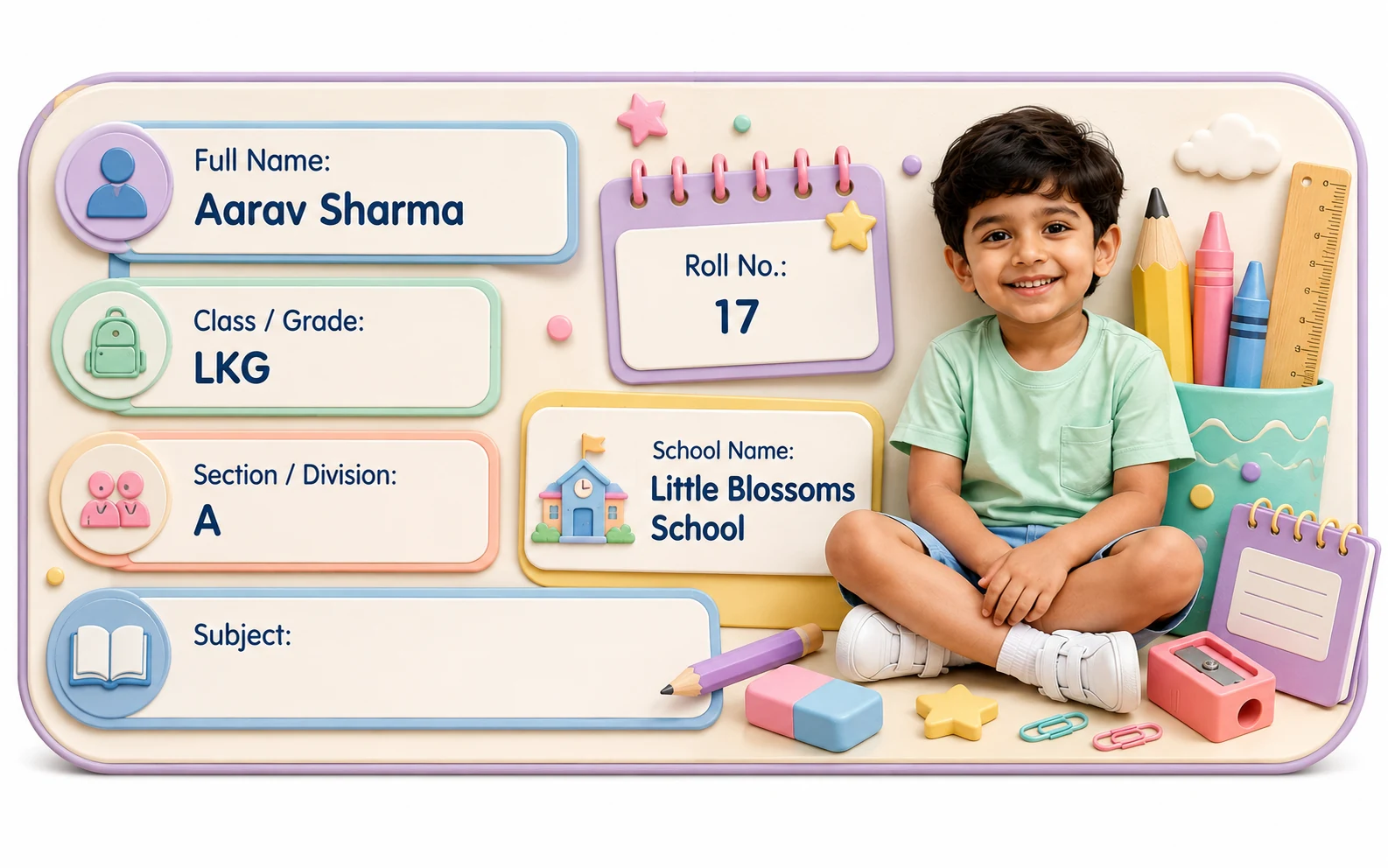
Neutral editorial examples using fictional details. These are not Dimple product previews or promises of editable layouts.
Labeling school belongings for one child is relatively simple.
Labeling for two or more children creates a different problem.
Now you are managing:
- different names,
- different classes,
- different sections,
- different roll numbers,
- different subjects,
- sometimes different schools,
- sometimes the same school,
- shared stationery,
- similar notebooks,
- hand-me-down folders,
- old labels,
- leftover sheets,
- different themes,
- and sometimes the same surname on everything.
That is where mistakes happen.
A notebook prepared for Child A ends up in Child B’s bag.
A project file still carries an older sibling’s label.
Two children choose the same theme, and the visual cue no longer helps.
A parent finds leftover labels and thinks:
“This surname is still correct—can I just use these?”
A leftover personalized slip is only appropriate when it still identifies the current child correctly.
The easiest way to organize sibling school labels is to use four categories:
Child-Specific → Shared → Hand-Me-Down → Update
That is the family system this guide will use.
The sibling system at a glance
| Item type | What it means | Label approach |
|---|---|---|
| Child-specific | Belongs to one child | Use that child’s current Name Slip |
| Shared | Used by more than one child | Do not force one child’s identity onto it |
| Hand-me-down | Ownership changed from one sibling to another | Remove/update conflicting identity where practical |
| Update | Details changed with new year/school/class | Recheck before reuse |
This is a workflow framework, not a school rule.
1. CHILD-SPECIFIC — keep ownership unmistakable
Most school belongings fall into this category.
Examples:
- textbooks,
- notebooks,
- project files,
- workbooks,
- pencil boxes,
- activity books,
- subject files.
If the item belongs to one child, the label should clearly identify that child.
For example:
ANANYA SHARMA
CLASS 1A
should not be used on:
Aarav’s notebook
even if both children:
- share the same surname,
- attend the same school,
- like the same theme.
The child name remains the primary identity.
Why surname alone is usually not enough for siblings
Suppose two children are:
ANANYA SHARMA
and
AARAV SHARMA
A label that only says:
SHARMA
does not distinguish ownership.
That may be fine for a truly shared family item.
It is less useful for:
- school notebooks,
- project files,
- submitted work,
- classroom books.
For child-specific belongings, use the child’s identifying name in the format the family/school prefers.
What if both siblings attend the same school?
That actually makes accurate child-specific labeling more important.
The shared school name does not distinguish:
- child,
- class,
- section,
- roll number.
For example:
BRIGHT STARS SCHOOL
may be true for both children.
But:
ANANYA SHARMA — CLASS 1A
and:
AARAV SHARMA — CLASS 3B
are clearly different.
The shared institution should not become the dominant identifier.
What if the siblings are in the same class?
This can happen with:
- twins,
- children close in age,
- same-age siblings,
- special family situations.
Now class/section may not distinguish them.
The child’s name becomes even more important.
If both children also share:
- surname,
- section,
- school,
avoid a label format where the first name is visually tiny and the shared fields dominate.
For format hierarchy:
What if the siblings have similar names?
For example:
Aarav Sharma
and:
Aarush Sharma
A fast glance can still create confusion.
Helpful options include:
- keeping the full child name readable,
- using distinct approved photos,
- choosing different themes,
- using different visual systems where the family prefers.
Do not force artificial name abbreviations just to make the labels look different.
The family/school naming convention should remain the source of truth.
2. SHARED — do not pretend a shared item belongs to one child
Some family items are genuinely shared.
Examples might include:
- craft supplies kept at home,
- family stationery,
- storage boxes,
- art materials,
- home reference books,
- shared activity kits.
A child-specific school Name Slip may not be the right solution for these.
If an item is genuinely shared between siblings, labeling it:
ANANYA SHARMA
can create false ownership.
Before using a child-specific Name Slip, ask:
Does this item actually belong to this child?
If the answer is:
“Both use it,”
then a shared-family organization method may be more appropriate.
Shared at home does not always mean shared at school
This distinction matters.
A box of crayons may be shared at home.
But if the school requires:
one pencil box per child,
then each school-use set becomes child-specific.
The use context decides.
Do not label based only on who owns the item at home.
Label based on how the item functions in the school routine.
Should siblings share one Name Slip sheet?
Dimple’s current Name Slip format is one child and one selected details/theme set per sheet. Prepare each sibling’s personalization separately. A shared surname does not turn one personalized sheet into a two-child product.
Can siblings choose the same theme?
Yes, if they want to.
Themes do not need to be different simply for the parent’s organizational convenience.
The actual identification should come from:
- child name,
- photo where used,
- class/section,
- other relevant school details.
A theme is a secondary cue.
Do not rely on:
“pink = Child A”
“blue = Child B”
as the only ownership system.
That can fail if:
- both choose the same theme,
- the family changes theme next year,
- the colors print differently,
- the item is viewed without the full design context.
Is it better to use different themes for siblings?
It can be helpful.
Different themes may make it easier for:
- parents,
- children,
- teachers
to distinguish belongings at a glance.
But this is optional.
Different themes should support clear identity, not replace it.
A well-designed system should still work if both children choose the same theme.
Can siblings use the same child photo?
No, not as an identity shortcut.
If photo personalization is used, each child’s product should use the correct child’s approved photo.
Do not reuse one child’s photo for another child simply to create a consistent family look.
For photo selection:
3. HAND-ME-DOWN — ownership changed, so identity must change too
Sibling families often reuse:
- folders,
- files,
- books,
- storage pouches,
- covers,
- activity kits,
- pencil cases.
That can be sensible.
But when the item moves from one child to another, the visible identification may need to change.
An old label saying:
ANANYA SHARMA — CLASS 2A
on Aarav’s current project file can create confusion.
The fact that the physical item is reusable does not mean the identification remains reusable.
What should you do with an old sibling label?
Check whether the old identity is visible and could conflict with the new owner. Make current ownership unambiguous while following the item’s surface guidance. Removal, layering and residue behavior depend on the actual product and surface; avoid leaving two conflicting child identities visible.
Can I place a new label over the old sibling’s label?
Only consider it when the item and surface guidance permit it and the result clearly shows the current owner without covering important information. If layering would damage the item or leave conflicting identities visible, choose another suitable way to identify it. No universal layering or residue-free removal performance is assumed.
What about textbooks passed from an older sibling?
A textbook may have:
- old name,
- old class,
- old school year,
- old section.
If the younger sibling now uses it:
the current label should make ownership clear.
However, do not cover:
- official school barcode,
- library code,
- ISBN area,
- school-issued sticker,
- title information
if those need to remain visible.
For placement:
How to Label School Books and Notebooks Properly: Placement, Readability & 7 Mistakes to Avoid
What about hand-me-down notebooks?
A partially used notebook may not be suitable for school reuse if the school has its own rules.
Do not make a universal recommendation.
If the notebook is being reused legitimately:
make sure the visible identification matches the current child.
School instructions come first.
4. UPDATE — siblings multiply the number of changing details
With one child, a parent may need to update:
- class,
- section,
- roll number,
- subject.
With two or three children, the number of changing details multiplies.
That makes a yearly audit more important.
For each child, verify separately:
NAME
Correct spelling and preferred format.
CLASS
Current year.
SECTION
Current allocation.
ROLL NUMBER
Confirmed, not guessed.
SCHOOL
Same institution/branch?
SUBJECT
Relevant to the specific item?
PHOTO
Still appropriate if used?
THEME
Still wanted?
Do not copy last year’s sheet simply because the surname or school remained the same.
The sibling annual audit
Make one mini-checklist per child.
CHILD A
Name
Class
Section
Roll
School
Photo
Theme
CHILD B
Name
Class
Section
Roll
School
Photo
Theme
CHILD C
Repeat separately.
Do not create one family master line such as:
“School: same for everyone”
and assume all other details match.
The more children in the family, the more valuable a child-by-child audit becomes.
For the full new-year checklist:
New School Year Name Label Checklist: What to Update Before Class, Section or Roll Number Changes
A simple sibling sorting system
Before applying labels, sort school belongings into piles.
PILE 1 — CHILD A
All Child A books/files/items.
PILE 2 — CHILD B
All Child B belongings.
PILE 3 — SHARED
Items genuinely shared.
PILE 4 — HAND-ME-DOWN
Items whose ownership changed.
PILE 5 — UNCERTAIN
Anything you are not sure about yet.
Do not apply labels to the “uncertain” pile until ownership/details are confirmed.
This prevents last-minute mistakes.
Why an “uncertain” pile is useful
Parents often make labeling mistakes because everything is done in one rush.
Examples:
- “I think this is Aarav’s.”
- “This section is probably still B.”
- “This file belonged to Ananya last year.”
- “I’ll just use the remaining label.”
A temporary uncertain pile is better than permanently personalizing a guess.
The broader Dimple rule remains:
Do not print or apply uncertainty.
Should siblings use different colors?
Optional.
Color can support organization.
For example:
Child A: lavender family theme
Child B: space theme
But color should remain a secondary cue.
Primary identification should remain:
- name,
- relevant school context,
- photo where used.
Do not create accessibility problems by using color alone to distinguish belongings.
Should twins use different label designs?
Only if they want to.
Twins may:
- prefer identical themes,
- prefer different themes,
- prefer matching layouts with different photos/names.
All are valid.
The important part is:
the visible child identity must remain unambiguous.
Do not overcomplicate the family system simply because the children are twins.
Should siblings in the same school use the same format?
They can.
For example:
NAME
CLASS + SECTION
for both children.
That creates a family-wide system.
But the actual details must remain child-specific.
A shared format can improve consistency without erasing individual identity.
This is often a good balance:
same structure, different child data.
Should siblings in different schools use different formats?
Maybe.
Different schools may:
- request different details,
- use grade vs class terminology,
- use roll numbers differently,
- have different labeling rules.
Do not force one family-wide format if the schools require different information.
School instructions outrank family visual consistency.
What if one child needs a photo and another does not?
That is fine.
A family does not need to use one identical personalization policy for every child.
For example:
Child A: Photo + Name + Class
Child B: Name + Class + Section
The decision may depend on:
- age,
- preference,
- school context,
- privacy comfort,
- layout.
Do not force uniformity merely for aesthetics.
For the photo-vs-text decision:
Photo Name Slips vs Text-Only Name Labels: Which Is Better for School?
What if siblings have different privacy needs?
Treat each item and child separately.
A younger child’s internal notebook may use one amount of information.
An older child’s public-facing bag may justify less visible detail.
Do not create a single “family privacy rule” if the contexts differ.
For broader field/privacy guidance:
What Should You Put on a Child’s School Name Slip? Name, Class, Section, Roll Number & Privacy Guide
Siblings and subject labels
Subject-specific labels can become especially confusing in multi-child households.
Example:
Two children both have:
- Mathematics
- English
- EVS
If only the subject is prominent, the books can still get mixed.
The child name should remain the stronger identity.
A subject is supporting context.
For format hierarchy:
Siblings and long names
A short name and a longer name may need different text treatment. Aim for consistent clarity rather than identical font size. Read how to keep long names readable on school Name Slips for the full decision.
What about leftover Name Slips from one sibling?
Do not use them for another child unless the visible identity is genuinely appropriate.
For Dimple, a sheet is personalized around one child/details/theme set.
A leftover sheet from Child A remains Child A’s personalized product.
The shared surname does not make it a generic family label.
You may still use leftover slips for Child A if:
- details remain current,
- the item use is appropriate.
For annual recheck:
New School Year Name Label Checklist: What to Update Before Class, Section or Roll Number Changes
What if both siblings have the same first initial?
Initial-based labeling becomes even less useful.
For example:
A. SHARMA
could mean:
- Ananya Sharma
- Aarav Sharma
If the school uses initials, follow its instruction.
Otherwise, a clearer child name may reduce ambiguity.
Do not shorten names merely for design convenience.
What if siblings share the same bag or storage bin?
If the item is truly shared at home:
a family-level label can be reasonable.
If the item travels to school with one child:
it becomes child-specific for that use.
Context matters more than ownership history.
What if siblings swap pencil boxes?
If the school item is being intentionally reassigned from one child to another:
treat it like a hand-me-down.
The current visible label should identify the current child.
Do not leave:
- old child name,
- new child name
both clearly visible if that could create confusion.
What if the sibling is in preschool/daycare?
Check each item separately. Clothing, bottles and wet-use belongings can require different verified product properties from books and notebooks. Dimple Name Slips have no established washable, waterproof or fabric-use promise. Dimple Stickers are a separate vinyl, waterproof family; that is not a blanket suitability claim for every daycare item. Use the school-item labeling guide to separate the decisions.
One family, one system — but not one label
This is the key distinction.
A family can absolutely use one organizational system:
- same checklist,
- same sorting method,
- same field hierarchy,
- same annual audit.
But that does not mean:
one personalized label fits every child.
The system can be shared.
The identity cannot.
The Dimple sibling framework
Use:
CHILD-SPECIFIC
Who owns it now?
Use the current child’s label.
SHARED
Is it genuinely used by more than one child?
Do not force one child’s identity onto it.
HAND-ME-DOWN
Did ownership change?
Update the visible identity.
UPDATE
Did school details change?
Recheck before reuse.
This framework works whether the family has:
- two children,
- twins,
- three children,
- siblings in different schools.
A practical 15-minute sibling Name Slip setup
Minute 1–3 — Sort by child
Create one pile per child.
Minute 4–5 — Create shared pile
Move genuinely shared items out.
Minute 6–8 — Identify hand-me-downs
Find anything with an older sibling’s old label.
Minute 9–11 — Verify current school details
Class
Section
Roll
School
Minute 12 — Verify photo/theme
One child at a time.
Minute 13–14 — Match correct Name Slip sheet to correct pile
Do not mix sheets.
Minute 15 — Final check before applying
Child
Item
Label
Details
Use this as an example schedule; take the time your family needs to verify the details.
8 common sibling labeling mistakes
1. Assuming the same surname is enough
It may not identify which child owns the item.
2. Using one sibling’s leftover labels for another
The child identity is still wrong.
3. Keeping an older sibling’s visible label on a hand-me-down
The item may now route to the wrong child.
4. Relying only on theme/color
Themes can repeat or change.
5. Copying the same class/section details across siblings
Even children at the same school have separate school details.
6. Labeling shared items as child-specific
That creates artificial ownership.
7. Applying labels before checking the new year’s details
Class/section/roll may have changed.
8. Mixing personalization sheets while labeling in a hurry
Apply one child’s sheet at a time.
A sibling order-preparation checklist
Before ordering or approving personalized Name Slips:
CHILD 1
- correct name
- correct photo
- correct class
- correct section
- correct roll number
- correct school
- chosen theme
CHILD 2
Repeat separately.
CHILD 3
Repeat separately.
Then verify:
- each child has their own personalization,
- no details were copied accidentally,
- the correct photo belongs to the correct child,
- the correct theme is attached to the correct child.
This is especially important when orders are prepared back-to-back.
What if both children want the same Dimple theme?
Let them.
The child data remains the differentiator.
Do not discourage the same theme simply because the parent wants easier sorting.
If easier home sorting matters, use:
- child name,
- photo,
- separate storage piles,
- sheet-by-sheet application
rather than forcing theme differences.
What if one child changes schools mid-year?
Treat that child as an update case.
Do not automatically replace the other sibling’s labels.
Each child’s information lifecycle is separate.
This is why a sibling system should be:
family-organized but child-specific.
What if a younger sibling inherits almost everything?
You can still reduce waste without preserving outdated identity.
Reuse the physical item where appropriate.
Update:
- name,
- school details,
- current child ownership.
The objective is not to throw away belongings.
It is to prevent old personalization from misidentifying the current owner.
What if two siblings have identical notebooks?
This is exactly where Name Slips help.
If:
- covers match,
- subjects match,
- school matches,
the child-specific identity becomes the key differentiator.
Use:
- clear child name,
- photo if desired,
- class/section where useful.
Do not rely on small handwritten marks that can be missed.
What if only one child needs labels right now?
Do not buy/order for the second child merely to keep the family system symmetrical.
Label what genuinely needs labeling.
The sibling system is an organizational framework, not a requirement to order identical quantities for everyone.
Before you approve
Managing school Name Slips for siblings is not mainly a design problem.
It is an ownership problem.
Use four buckets:
Child-Specific → Shared → Hand-Me-Down → Update
For child-specific items:
use the correct child’s current personalization.
For shared items:
do not force one child’s identity onto them.
For hand-me-downs:
update the visible identity when ownership changes.
For the new school year:
recheck school details separately for each child.
The strongest family system is not:
one label style for everyone.
It is:
one clear process, with each child’s identity kept separate.
Frequently asked questions
Can I use one Name Slip sheet for two siblings?
Dimple’s current Name Slip format uses one child/details/theme set per sheet. Prepare each child’s personalization separately.
Can siblings use the same Name Slip theme?
Yes. The theme can be the same. The child’s name and other relevant details should still make ownership clear.
Should siblings use different colors?
They can, but color should be a secondary cue rather than the only identifier.
Can I use leftover labels from one child for another sibling?
Not if the labels still display the wrong child’s identity. A shared surname does not make a personalized label interchangeable.
What should I do with an older sibling’s label on a hand-me-down?
Update the visible identity so the current child is clear. Avoid leaving two conflicting child identities visible.
Can twins use matching Name Slips?
Yes. Matching designs are fine as long as each child’s visible identifying details remain clear.
What if both siblings are in the same class?
Use the child name as the strongest identifier. Class alone will not distinguish them.
Should siblings use the same label format?
They can use the same layout structure for consistency, but the actual child details should remain separate.
What if the siblings attend different schools?
Follow each school’s labeling requirements separately. Do not force one family-wide format if the schools require different information.
Can siblings share labels for common home items?
If an item is genuinely shared, a child-specific school Name Slip may not be the right labeling method. Use a shared-family organization approach instead.
Ready to check a design with your child’s details?
Choose a Name Slip design
Compare the current designs and inspect the personalized preview before ordering.
Browse Dimple Name SlipsUnderstand the steps
See how details, photo, preview review and ordering fit together.
How personalization works