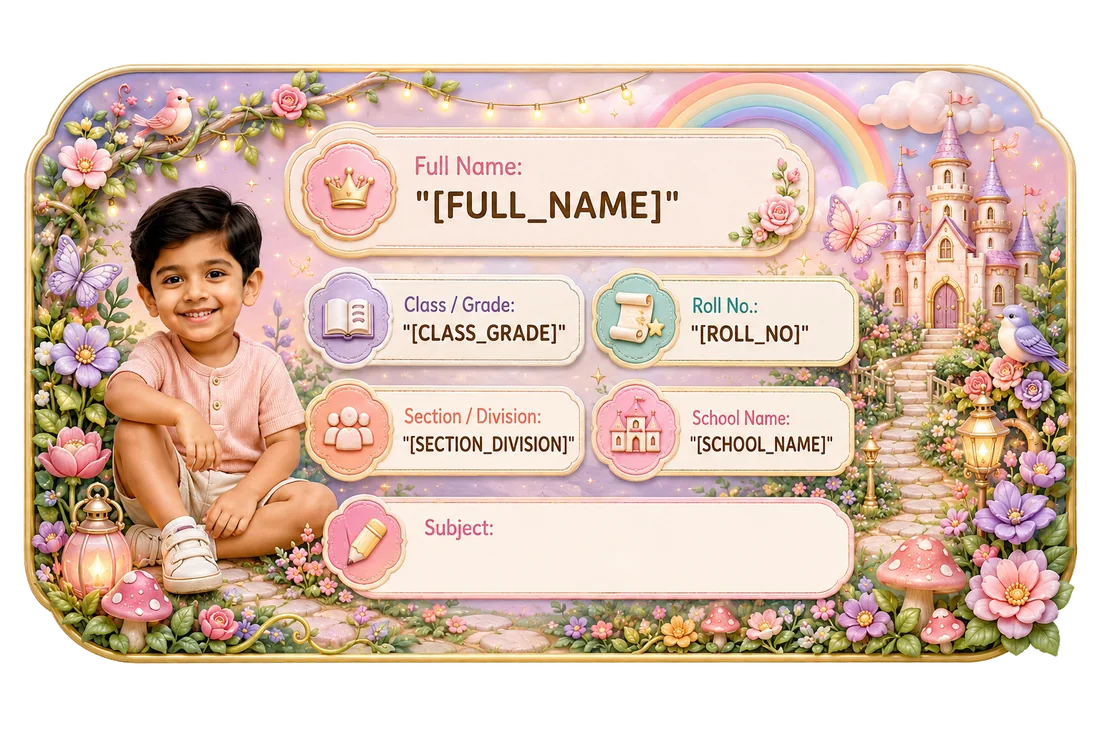
 Fairytale Garden Name Slip
Real Dimple product example.
ITEM → EXPOSURE → INFORMATION → PRODUCT TYPE — a practical decision framework for school identification.
Fairytale Garden Name SlipReal Dimple product example.
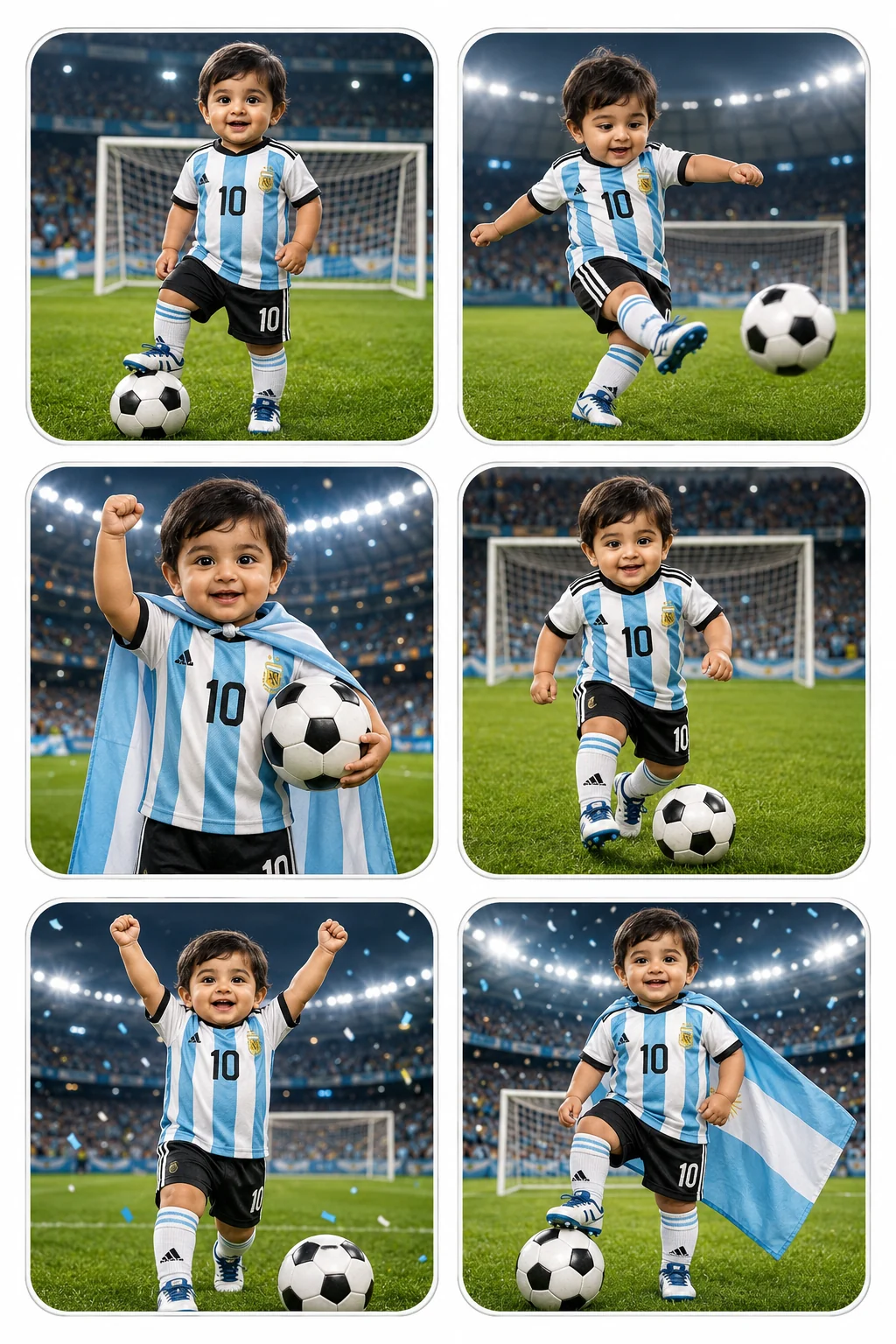 Messi Football Star Sticker
Real Dimple product example.
Editorial context, not a product claim.
School shopping usually starts with a list.
Books. Notebooks. Pencil box. Bottle. Lunch box. Files. Art supplies. Maybe a school bag, activity folder or a set of items for tuition.
Then comes another question:
Which of these things should actually have your child’s name on them?
The answer is not “everything”.
A useful label should solve a real problem: helping your child recognise an item, helping a teacher or school staff member return it, or reducing mix-ups between belongings that look similar.
For many parents, the easiest place to start is:
Label the items that are easy to mix up, easy to leave behind, or regularly handled outside the home.
But the type of identification should depend on the item.
A school notebook and a water bottle do not face the same conditions. A project file may need class and section details. A public-facing bag may call for less personal information. And a product described as a “name label” is not automatically suitable for every surface.
A simple way to decide is:
Item → Exposure → Information → Product type
That keeps the decision practical instead of turning every belonging into the same labeling job.
Use this as a starting point, then follow your child’s school instructions where they differ.
| School item | Usually worth identifying? | What matters most | Practical starting point |
|---|---|---|---|
| Textbooks | Often yes | Owner + class/section | Name Slip or school-required format |
| Notebooks | Often yes | Owner + class/section/subject | Name Slip |
| Project files/folders | Often yes | Clear school identification | Name Slip |
| Pencil box | Often yes | Compact identification | Choose based on available flat area and product format |
| Water bottle | Often yes | Identification + water exposure | Review a product whose verified properties suit the use |
| Lunch box | Often yes | Identification + cleaning/exposure | Check the exact product guidance before choosing |
| Art/craft box | Often useful | Easy recognition | Depends on surface and available space |
| Calculator / geometry box | Often useful | Compact identification | Small, readable label/product if appropriate |
| School bag | Situational | Identification vs public visibility | Use only the information genuinely needed |
| Uniform/clothing | Often school-dependent | Fabric-specific identification | Use a product specifically designed/verified for fabric |
| Books kept only at home | Usually lower priority | Low mix-up/loss risk | Label only if useful |
| Expensive/special equipment | Often useful | Return if misplaced | Follow school rules and product/surface guidance |
The table is not a universal rule.
The school’s own requirements come first.
A good labeling checklist is not based on how many products you can cover.
It is based on how school life actually works.
Items become good candidates for identification when they are:
That is why a plain blue notebook may benefit from a clear Name Slip more than a unique item that never leaves home.
The goal is not maximum labeling.
The goal is useful identification.
Books are one of the most obvious places to start.
Many students in the same class may carry the same textbook. Once several copies are stacked together, the cover alone may not tell anyone which child owns which book.
For a school book, the useful information may include:
You do not necessarily need every field.
For many school books, name + class + section is a strong starting point.
Dimple’s Name Slips are designed around school-identification details, so this is the product family to review when the main job is clear identification on books, notebooks and files.
Dimple’s personalised Name Slips
For a deeper field-by-field decision, link to:
Notebooks are even easier to mix up because schools often ask children to use similar covers, colours or sizes.
A useful notebook label may help answer two questions immediately:
Whose notebook is this?
and:
Which class or subject does it belong to?
If your child has separate notebooks for Mathematics, English, Science or another subject, subject identification may also be useful.
However, do not overcrowd a small label.
If you need:
Name + Class + Section + Roll Number + Subject + Photo
then layout space becomes important.
Dimple’s Name Slip sheet currently includes both large and small formats, so the right choice depends on the actual notebook and how much information needs to remain readable.
Project files often move through more hands than an everyday notebook.
A teacher may collect them, return them later, store them together, or move them between classrooms.
That makes clear identification particularly useful.
A project file may benefit from:
There is usually more flat space available on a file or folder than on a small stationery item, so readability should take priority over squeezing the design into the smallest possible area.
Use the label where it can be seen easily without covering important printed information.
Pencil boxes are common candidates for identification because many children carry similar designs.
But “pencil box” is not a single standard size or surface.
One may have a large flat lid.
Another may be narrow, curved or textured.
So do not decide based only on the item name.
Check:
For many pencil boxes, a shorter identification format may be enough.
For example:
ANANYA SHARMA CLASS 1A
may be more practical than trying to fit every school field.
Water bottles are one of the most commonly misplaced school items.
They also introduce an important difference:
water exposure matters.
Do not assume a printed school Name Slip and a waterproof Sticker are the same product simply because both can be called “name labels” in everyday conversation.
Dimple’s Sticker product family has two verified product facts:
Vinyl
and:
Waterproof
Dimple’s Name Slips should not inherit those claims automatically.
If you are considering a Dimple product for an item that regularly encounters water, review the current Sticker product information and the exact intended use before ordering.
Dimple’s vinyl waterproof Stickers
Important:
Waterproof does not automatically mean:
Those are separate product questions.
Lunch boxes are also worth identifying because many children carry similar shapes and colours.
But the decision should consider more than the name.
Ask:
Do not turn the word “waterproof” into a blanket promise about every cleaning method.
If the lunch box is regularly exposed to conditions beyond ordinary water contact, check the exact current product information before applying a personalised product.
The safest SEO and product-truth rule is also the most useful parent rule:
Do not infer a product property that has not actually been stated.
A school bag may seem like an obvious place for a large name label.
But this is where public visibility becomes more important.
A notebook inside a classroom and a backpack carried through public spaces are not the same privacy decision.
Before displaying:
on the outside of a bag, ask whether each detail is genuinely necessary.
Sometimes less information is enough.
For a publicly visible item, a family may prefer a more limited identifier instead of reproducing the same information used on an internal school notebook.
[INTERNAL LINK: /blog/what-to-put-on-school-name-slip/]
The principle is:
Enough to identify. Enough to return. No more than you need.
Art supplies are easy to mix up because children may use similar boxes, folders and kits.
The best identification method depends on the actual item.
For a paper folder or project file, a Name Slip may make sense.
For a hard container, the surface and exposure conditions matter.
Do not make the decision based on whether another retailer happens to call its product a “label”.
The underlying product matters more than the word.
Small school items present a different problem:
space.
The most useful label is not the one containing the most fields.
It is the one that remains easy to read.
If the available area is small, consider whether:
is enough.
Do not shrink five lines of information until none of them are readable.
If the item is very small or has no suitable placement area, another identification method may be better.
Clothing requires special care because fabric is a different use case from books or hard school items.
A vinyl Sticker is not automatically a clothing label.
A printed Name Slip is not automatically a washable uniform label.
If you need identification for:
use a product specifically designed and verified for the relevant fabric/laundry conditions.
Do not infer fabric suitability from the words:
“name label”
or:
“waterproof”.
At the moment, Dimple should not market its Name Slips or standard Stickers as clothing labels unless separate product evidence supports that use.
Some belongings should not be labeled simply because there is empty space.
Avoid covering:
If the school has its own identification system, follow that system first.
A personalised label should complement school administration, not obscure it.
When you are standing in front of a pile of school supplies, use this quick framework.
What exactly are you identifying?
A book, notebook, file, bottle, bag and uniform are different problems.
What will the item face?
Ask about:
What is the minimum useful information?
Possible fields include:
Use only what genuinely helps.
Now choose the product.
Do you need:
The search term is not the specification.
You can use this before the first week of school.
There is no prize for labeling the highest number of objects.
The goal is to reduce confusion and make important belongings easier to recognise and return.
Books and water-exposed items have different needs.
More information is not automatically more useful.
If the school gives a label format, follow it.
These details can change with a new academic year.
Measure first where size/readability matters.
Dishwasher, abrasion, sunlight and fabric use are separate questions.
Spelling, class details, photo placement and readability should be checked before approval.
A useful way to think about it is to match information to the environment.
For books, notebooks and project files:
Name + Class + Section
is often a good starting point.
Add roll number or subject where useful.
Keep the identifier compact enough to remain readable.
Consider whether full school information or a child photo is genuinely necessary.
Choose based on verified product properties, not simply the word “label”.
Use a product specifically designed and verified for fabric.
Not necessarily.
Different children may have:
Use one consistent family system where it helps, but do not force the same information onto every child’s belongings if the context differs.
Before reusing old personalised labels, check:
A child’s name may stay the same, but school details often do not.
If an old label has outdated information, finishing the sheet just to avoid waste can create confusion.
This topic deserves its own new-school-year checklist.
[PLANNED INTERNAL LINK AFTER ARTICLE #10 IS PUBLISHED: /blog/new-school-year-name-label-checklist/]
Use this five-question check:
Book? File? Bottle? Pencil box?
Dry classroom use? Water? Cleaning? Public visibility?
Name only? Name + class + section? Something else?
Review:
[INTERNAL LINK: /name-slips/]
and:
[INTERNAL LINK: /stickers/]
as separate product families.
Check:
You do not need to label every object a child owns.
Start with the belongings most likely to be:
mixed up, misplaced or handled away from home.
Then make four decisions:
Item → Exposure → Information → Product type
For books, notebooks and project files, a school-focused Name Slip may make sense.
For situations where water exposure matters, look at a product whose verified properties match that need. Dimple’s Sticker family is confirmed as vinyl and waterproof, but additional durability claims should be checked separately.
For bags and other publicly visible belongings, think about how much personal information really needs to be displayed.
For clothing, use a product designed and verified for fabric.
And whatever you choose, check the personalised preview before ordering.
The best school label is not the one that says the most.
It is the one that gives the right information, on the right item, in the right product format.
Browse Dimple’s current personalised products and choose the product family that matches the item you want to identify.
Primary CTA: Browse Dimple Name Slips Target: /name-slips/
Secondary CTA: Explore Dimple Stickers Target: /stickers/
Do not make the secondary CTA visually compete with the primary CTA unless the article design naturally supports a two-path choice.
Start with belongings that are easy to mix up or leave behind, such as books, notebooks, project files, pencil boxes, bottles and lunch boxes. Follow the school’s own labeling instructions where they differ.
Not necessarily. The amount of information should depend on the item, where it is used and how publicly visible it is. For many internal school items, name, class and section may be enough.
Choose by the actual product and use case, not the wording alone. Dimple Name Slips are a separate school-identification product family; Dimple Stickers are confirmed as vinyl and waterproof.
Do not assume that. The confirmed vinyl + waterproof product truth applies to Dimple Stickers, not automatically to Name Slips.
No such assumption should be made. Dishwasher exposure involves additional conditions such as heat, detergent and repeated cycles. Check the exact product guidance for any claim beyond waterproof.
It can be useful, but a bag is publicly visible more often than a notebook. Consider whether every personal detail is genuinely necessary before displaying it externally.
Do not assume a standard vinyl Sticker is a clothing label. Fabric and laundry use require a product specifically designed and verified for those conditions. ---
Browse Dimple’s printed Name Slips for school details.
Browse Name SlipsThis guide is practical product guidance. Check the current product page and checkout for live availability, price and delivery information.