
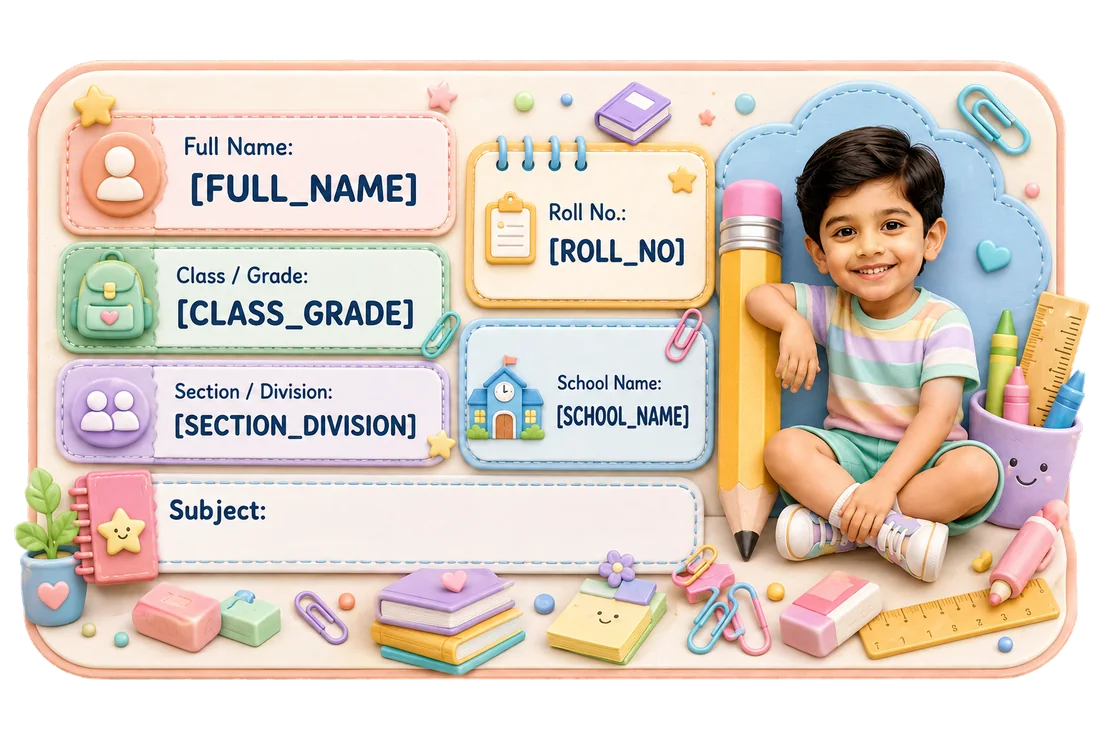
Quick answer: what should distinguish two similar notebooks?
Use the child's name and required class details to identify the owner. Then distinguish the book using:
Subject → Purpose → Book number, when required.
For example, “Maths — Practice” tells you something different from “Maths — Classwork.” Add “Book 1” only when the school uses a numbering system or you have agreed one with the teacher.
The child's identity can stay consistent across the set. The book's job should be clear on each individual notebook.
On this page
- Quick answer: what should distinguish two similar notebooks?
- Turn the school list into a book map
- Separate the owner's identity from the notebook's job
- Avoid assigning subjects by cover colour alone
- What if one subject needs several notebooks?
- Where should subject information go?
- How Dimple Name Slips fit into a subject-wise system
- Check the set before applying every label
- Common mix-ups to avoid
- Frequently asked questions
- Prepare the child details, then assign each book its job
Label each notebook with the child's identifying details and the exact subject and purpose specified by the school. When two books belong to the same subject, “English” alone may not distinguish them. “English — Classwork” and “English — Homework” provide a clearer choice if those are the school's terms.
Start with the book list rather than a pile of blank notebooks. Confirm which books the school expects before assigning labels.
Turn the school list into a book map
Before you write anything, place each notebook beside its instruction. Use a simple worksheet:
| School wording | Notebook to prepare | Distinguishing wording to confirm |
|---|---|---|
| English classwork | The specified English notebook | English — Classwork |
| English homework | A separate book, if requested | English — Homework |
| Hindi language | The book requested for language work | Hindi Language |
| Hindi literature | A separate book, if requested | Hindi Literature |
| Maths practice | The specified practice notebook | Maths — Practice |
This is an illustrative example, not a standard list for every school. Copy the terminology your child actually receives. A school might use “CW,” “HW,” “Written Work,” or another description.
A dated Grade V labelling circular from Neerja Modi School lists separate language and subject books. Its 2024–25 instructions are an example of why checking the actual list matters; they are not current requirements for your child's school.
Separate the owner's identity from the notebook's job
A Name Slip answers “Whose book is this?” The subject and purpose answer “Which of that child's books is this?” Both questions matter when notebooks look alike.
An illustrative label could read:
NEHA SHARMA
CLASS 3 · SECTION B
ENGLISH — HOMEWORK
The name, class and section connect the notebook with the child. The final line distinguishes it from her English classwork book.
Use the school's required name, roll number and other details. If you are still deciding which personal information belongs on the label, use the separate guide to what to put on a school Name Slip.
Avoid assigning subjects by cover colour alone
Different colours can make a set easier to sort, but write the subject too. Covers may be replaced, two books may share a colour, and another adult may not know your family system.
If the school specifies cover colours, follow those instructions. If it does not, a consistent colour system is an optional extra rather than a substitute for readable words.
The same applies to themes. A space design can identify a child's set, but it does not tell you which space-themed notebook contains homework.
What if one subject needs several notebooks?
Look for the reason they are separate. They might have different jobs, such as grammar and literature, or one may replace a filled book later in the year.
Do not automatically label a second notebook “Homework.” Check first. If it is a spare, leave its final subject-purpose assignment open until the teacher confirms how it will be used.
If the school requests numbered books, make the number visible alongside the subject. Keep the wording consistent: “Science — Book 1” and “Science — Book 2” are easier to compare than two unrelated abbreviations.
Where should subject information go?
Use the area the school asks you to use, with enough room for the wording. Keep the subject separate from the child's name so neither becomes difficult to read.
Do not cover a printed book title, school barcode, library identifier or instructions. For placement examples, see how to label school books and notebooks.
If the wording is crowded, review the layout before making every label smaller. Removing an unnecessary decorative element or using an appropriate larger format may help more than squeezing another line into the same space.
How Dimple Name Slips fit into a subject-wise system
Dimple's current Name Slips are supplied as one printed sheet for one child, with the same selected design and child details across the sheet. The Subject area is left blank for completion later.
That distinction matters: a sheet of personalized Name Slips is not a promise that each slip will arrive with a different subject printed on it. Plan the subject-specific step separately and check the current product instructions or ask Dimple about a suitable writing method if you are unsure.
The current sheet contains 20 large and five small slips. Count the actual notebooks before deciding what you need; the Name Slip quantity worksheet covers that separate decision.
Check the set before applying every label
- Match each notebook to the school's list, including the required ruling or format.
- Confirm the subject and purpose wording.
- Check the child's name, class and section once against the approved details.
- Lay the prepared labels beside their intended books.
- Read the subject-purpose line on each book before finishing the next one.
Keep an unassigned notebook aside when the instructions are unclear. Asking one question is easier than correcting a whole prepared set.
Common mix-ups to avoid
Using a broad subject name for two different jobs. Two labels saying “Hindi” may leave language and literature books indistinguishable.
Treating the book count as the subject count. Five subjects do not necessarily mean five notebooks. Use the actual list.
Completing all subject fields before checking the allocation. A spare book may have a different job later. Assign it when that job is known.
Frequently asked questions
Should every subject have a different Name Slip design?
It does not need to. Consistent child identification plus clear subject-purpose wording can distinguish the books. Follow school design requirements where they exist.
Can I write CW and HW instead of the full words?
Use those abbreviations if the school uses them and the child understands them. Otherwise, confirm the wording with the teacher rather than introducing your own shorthand.
Should a replacement notebook use the same subject label?
Keep the same subject and purpose. Add a book number or continuation wording only if the school requests it. Avoid presenting two books as interchangeable when one is a completed record.
Can I order a different printed subject on every Dimple Name Slip?
The current Name Slip format uses the same child details across the sheet and leaves Subject blank. Check with Dimple before assuming a per-slip subject-printing option is available.