
Quick answer: make the book easy to describe and return
Use this sequence:
Describe → Check → Ask → Confirm the return.
Write down the subject, the book's purpose and a few useful identifying features. Then use the school's normal process. Follow its access and communication rules rather than turning up at a classroom or lost-property room without checking.
On this page
- Quick answer: make the book easy to describe and return
- 1. Describe the exact book
- 2. Check the ordinary places before starting a wider search
- 3. Send one clear message through the usual school channel
- 4. Understand the return route
- 5. Confirm the book before taking it home
- What if you want to share a photo of the missing book?
- Before ordering a replacement
- Improve the identification once the immediate problem is resolved
- Where Dimple Name Slips can help
- Frequently asked questions
- Make identification one part of the return plan
Start by identifying the exact missing book, checking its last known location and contacting the school's usual teacher or lost-property channel. A readable name label can help someone connect a found book with its owner, but it cannot guarantee a return or tell you where the book is.
Before buying a replacement, check whether the book is still at school, was collected for marking, or was packed with another set of belongings.
1. Describe the exact book
“An English notebook” may describe several books in the same classroom. Include the details that would help someone recognize this particular one.
| Useful detail | Example of what to record |
|---|---|
| Subject and purpose | English classwork, rather than English generally |
| Book appearance | Blue cover, school crest, distinctive protective cover |
| Name on the book | The spelling actually written on the label |
| Class and section | The current details, if shown |
| Last known use | Taken to the library after the English lesson |
| Contents | A recent worksheet or the topic of the last completed page |
These examples are prompts, not details to invent. If you are unsure when the book was last used, say so.
A receipt or photograph you already have may help describe a textbook edition. Avoid assuming two books with the same subject are the same title or edition.
2. Check the ordinary places before starting a wider search
Check the school bag, home study area and any separate folder used that day. Ask the child whether the book was handed in, moved to another classroom or placed with materials for an activity.
If a book may have been collected for marking, ask the teacher before treating it as lost. For a school library book, use the library's own process. Do not replace a borrowed title without first checking what the school requires.
Keep the questions simple. The aim is to reconstruct the book's route, not require the child to produce a perfect account immediately.
3. Send one clear message through the usual school channel
A useful message identifies the book and asks what to check next. For example:
My child's English classwork notebook has been missing since Tuesday afternoon. It has a blue cover and is labelled with the child's name and Class 3B. Could you please confirm whether it was collected for marking or where we should check for lost property?
This is a fictional message template. Add the child's identifying details only through the school's appropriate communication channel.
If the school asks for a form or a particular contact, use it. Avoid sending repeated messages to several unrelated staff members before the usual contact has had a chance to advise.
4. Understand the return route
A label is most useful when a finder can take the next step:
Found book → Readable owner details → School contact or class → Ownership check → Return.
A current class or section can help route an item inside a school that uses those details. That does not mean every book needs a parent's phone number, and it does not establish one universal school procedure.
Ask how the school handles found books and when pupils or parents may check. Published procedures differ. For example, a 2023 Broadbeach State School notice connects current class information with classroom returns. It is an example of one school's process, not a present-day rule for your child's school.
5. Confirm the book before taking it home
A familiar cover is a useful clue, but check the name and contents. Two classmates can have identical books, similar covers or the same first name.
If the book belongs to another child, return it through the teacher or school's normal channel. Do not change its label to make it part of your child's set.
If same-name confusion is recurring, agree a clearer identifying format with the teacher. A confirmed surname or school-assigned detail may help, depending on the situation.
What if you want to share a photo of the missing book?
Use a description where that is enough. If a photo is useful, crop it to the relevant book and check what is visible before sharing.
A cover or open page may show a child photo, full name, school details, another pupil's work or personal notes. Keep school communication within the appropriate channel and follow the school's rules about sharing images.
You do not need to publish a child's full details in a public post to begin an ordinary school lost-property enquiry.
Before ordering a replacement
Ask whether the child needs a temporary exercise book, a particular replacement edition or another arrangement while the search continues.
If you replace a notebook, confirm how to distinguish it from the original if that later returns. The teacher may want the books kept separately or the work handled in a particular way. Do not invent “Book 2” unless that numbering fits the school's system.
For a borrowed book, follow the lender's replacement process. Buying a similar-looking title may not resolve the missing item.
Improve the identification once the immediate problem is resolved
Check whether the missing book had a readable name, current class details and a clear subject-purpose description. Correct a genuine gap; do not assume a new label alone will prevent future losses.
A short routine can help: compare the books required for the next day with the ones in the bag, then check what came home. The book labelling and placement guide explains where identifying details can go, and the school-information guide explains which details can help identify a book.
If one book was missing, that does not automatically mean the entire label set needs replacing. Keep accurate, readable labels and update the items that actually need attention.
Where Dimple Name Slips can help
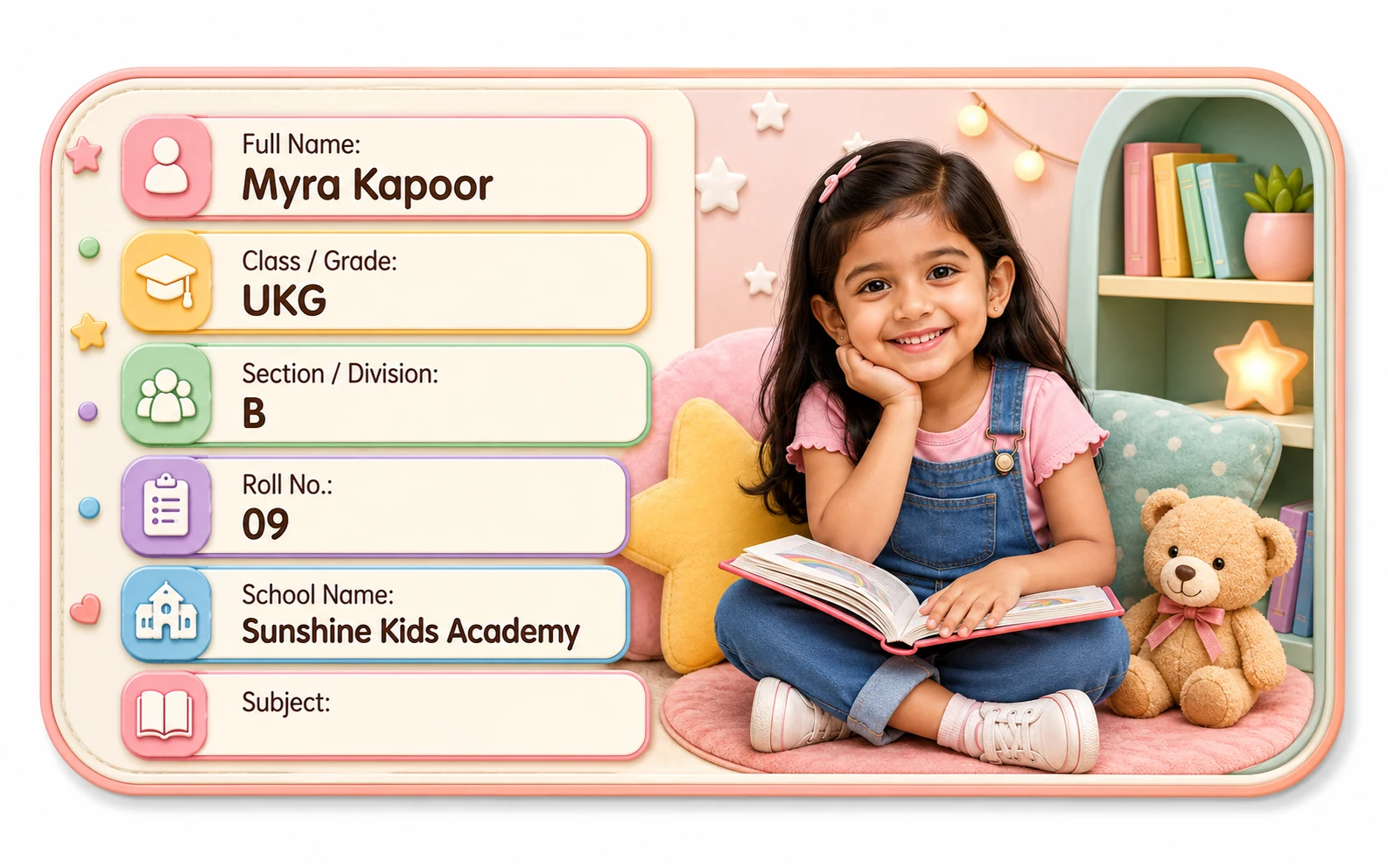
Dimple Name Slips provide printed child identification for school books and similar uses, with a child photo and supported school details. They can make the information easier to present consistently across a child's set.
They are physical printed labels. Do not treat them as location trackers, a digital lost-property registration service or a guarantee that a missing book will be returned. Keep official school and library identifiers unobstructed when choosing placement.
Frequently asked questions
Does a name label guarantee that a school book comes back?
No. It can help identify and route a found item, but the book must still be found and returned through an appropriate process.
Should I print a parent's phone number on every notebook?
Ask what the school needs. A classroom book may already have a suitable return route through the teacher or school office. Use only the information needed for the context.
Should I buy a replacement immediately?
Check the teacher or lender's instructions first. The book may be held for marking, and a replacement may need a particular title, edition or format.
What if the original turns up after we have started a replacement?
Ask the teacher how to handle the two books. Keep the completed work identifiable and avoid treating them as interchangeable without checking.