
Quick answer: add the smallest useful distinction
Work through this order:
Compare the names → Confirm the school detail → Check the finished label.
A surname may solve a shared-first-name problem. A confirmed roll number may help where full names and class details match. The school should decide what it wants used when ordinary identifiers remain ambiguous.
A different colour or theme can be an extra cue, but the written identity still needs to stand on its own.
On this page
- Quick answer: add the smallest useful distinction
- Which detail actually separates the children?
- Shared first names: keep the identifying surname
- Identical full names need a school-agreed distinction
- What if the clearer name takes more space?
- Can a photo or a different theme help?
- Keep the same identifying form across the child's set
- What to check in a Dimple preview
- Three mistakes to avoid
- Frequently asked questions
- Confirm the distinction before choosing the layout
If two classmates share a first name, use the school's agreed identifying name and enough confirmed class information to tell their belongings apart. If their full names also match, ask the teacher which school-assigned detail should distinguish them. Do not invent a nickname or add private information simply to make the label different.
The aim is a label that the child, teacher and school office can interpret consistently.
Which detail actually separates the children?
| Situation | Detail to discuss with the school | What may still be ambiguous |
|---|---|---|
| Same first name, different surnames | The agreed first name and surname | First name alone |
| Same first name and surname initial | Enough of the approved surname to distinguish them | First name plus one shared initial |
| Same full name, different classes or sections | The required class and section | Full name without class context |
| Same full name and class | A confirmed school-assigned identifier, if requested | Class and section alone |
| No agreed distinction yet | Ask the teacher before preparing a full set | A parent-created suffix or nickname |
This table is a decision aid, not a school policy. Use the information the school asks for and check that it remains readable.
Shared first names: keep the identifying surname
Consider two fictional classmates, Aarav Sharma and Aarav Singh. A label saying only “Aarav” does not distinguish their books. If the school uses their first names and surnames, printing those names may resolve the problem without adding another personal field.
Check the actual names before shortening them. “Aarav S.” would still be ambiguous in this example.
The same principle applies to a common family name. A surname alone may identify several children in the same class. Use the identifying form the school and family have agreed rather than choosing the shortest possible text.
Identical full names need a school-agreed distinction
If two children have the same full name, adding their common class and section may still leave the problem unresolved.
Ask the teacher how work is distinguished in the classroom. A confirmed roll number may be relevant if the school uses it for this purpose. Check it against the current record rather than relying on memory or a previous year's number.
Avoid making up “Aarav 1” and “Aarav 2,” attaching an unwanted nickname, or describing a child's appearance on a label. A distinction that makes sense to one parent may confuse others or differ from the school's records.
Do not add a home address, date of birth or another sensitive identifier to solve an ordinary notebook mix-up. Start with the school's existing identification process.
What if the clearer name takes more space?
Protect the information that actually distinguishes the child. If removing the surname recreates the ambiguity, make the layout work around it.
Review optional information, the available space and the appropriate label size. A natural line break may help where the design supports it. Tiny text that technically fits is not a useful result.
The long-name guide covers full names, initials and line breaks in more detail. This article's decision comes first: identify which parts of the name must remain before solving the fit.
Can a photo or a different theme help?
A recognizable photo or distinct design can provide an additional visual cue. It should support the written details, especially when another person is sorting a stack of books without knowing each family's chosen theme.
Do not assume a photo guarantees correct identification. A small, unclear portrait or two similar designs can still be confusing. Check that the name and school-approved distinction remain readable.
For the separate format decision, compare photo Name Slips and text-only Name Labels.
Keep the same identifying form across the child's set
Once the teacher confirms a suitable format, use it consistently on the relevant belongings. Switching between a nickname, initials and a full name can recreate uncertainty even when each individual label looks tidy.
Check the school diary and other required records for the agreed spelling. If the child uses a preferred name that differs from school records, ask how it should appear on belongings instead of assuming one form must replace the other.
Consistency does not mean printing every available detail everywhere. A classroom notebook and an item visible outside school can have different requirements. The school Name Slip information guide helps decide what is needed for each context.
What to check in a Dimple preview
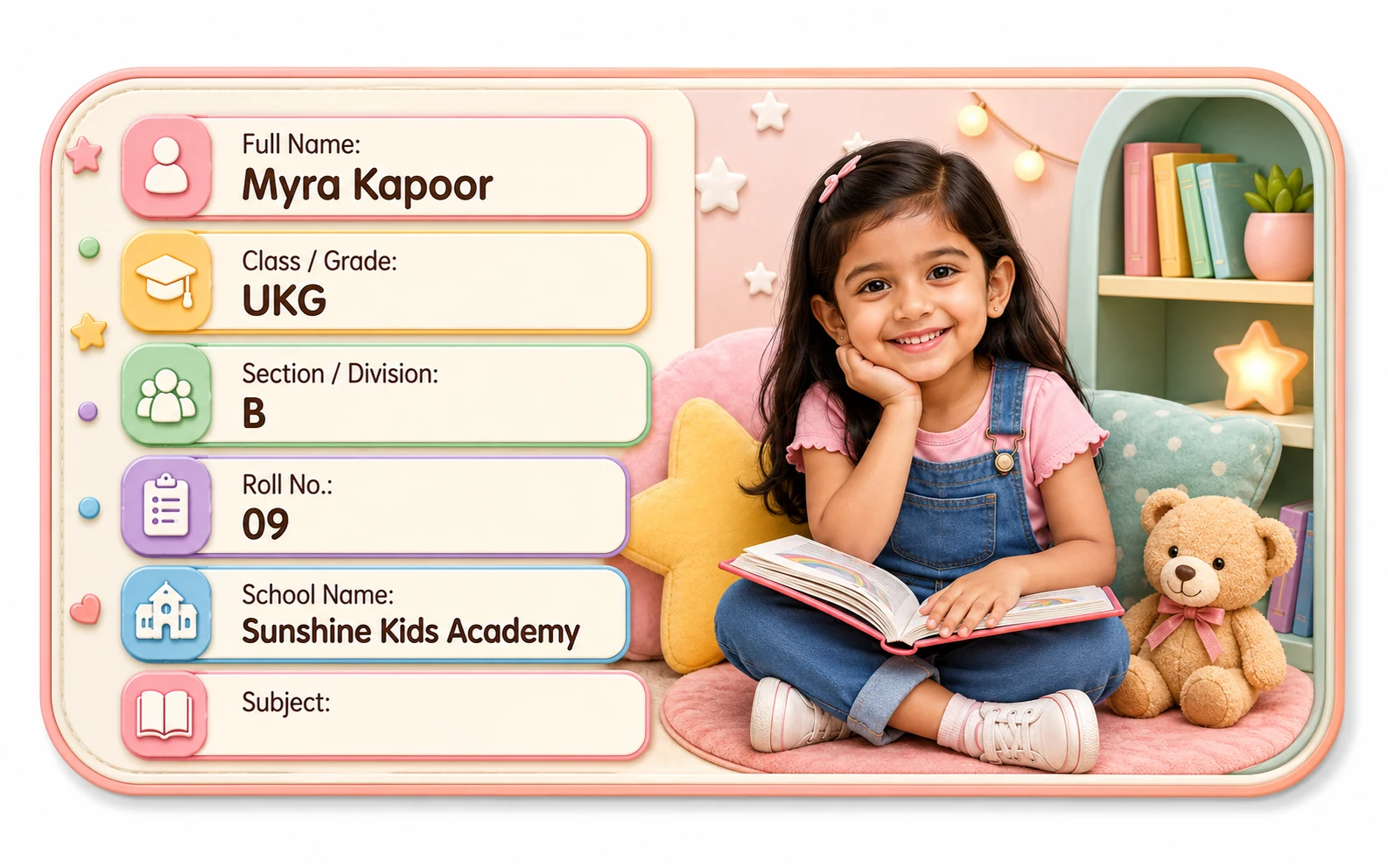
Dimple's current Name Slip fields include the child's name, class or grade, section, roll number and school name, alongside the photo. Use the supported fields to reproduce the confirmed details.
Before proceeding, compare the preview with the agreed wording. Check the entire identifying name, the surname, any required roll number and the smallest text. A large photo should not make the useful distinction unreadable.
Each current printed sheet is personalized for one child with one selected design and details set. It is not a classroom pack containing different pupils' information. Ask Dimple before assuming any additional field or mixed-child arrangement is supported.
Three mistakes to avoid
Shortening both children to the same abbreviation. Check whether the shorter form still distinguishes them.
Relying entirely on colour. Someone returning a book may know the child's name but not the chosen colour system.
Adding an unconfirmed number. A wrong identifier can be more confusing than a missing one. Confirm it before printing.
Frequently asked questions
Is a first name enough if it is uncommon?
It may be enough in some settings, but follow the school's requested format. This decision depends on the actual class and the information the school needs.
Should I always include a roll number?
Use it where the school asks for it or confirms that it helps distinguish the children. It is not automatically necessary on every belonging.
What if two children have the same first name and surname?
Ask the teacher which existing school-assigned detail to use. Do not improvise a nickname or add unnecessary private information.
Should I change every label when another child with the same name joins?
Check whether the existing labels are actually ambiguous. Update the relevant items if an agreed distinction is needed; a shared name alone does not mean every label must be replaced.