
Quick answer: settle the words before checking the design
Use four checks:
Approved spelling → Chosen script → Available layout → Finished proof.
Start with a reliable written reference, such as the spelling confirmed by the family and accepted in school records. Then check whether the selected product can reproduce that exact form clearly.
If the website rejects a character, do not silently change the child's name to make the form submit. Ask the supplier how to proceed.
On this page
- Quick answer: settle the words before checking the design
- Name spelling and label language are different
- Do not treat a child's name as a phrase to translate
- Check the small marks as carefully as the main letters
- What if the school asks for capital letters?
- Two scripts need a deliberate space decision
- Check the actual preview, including the smaller format
- What Dimple's current product information confirms
- Frequently asked questions
- Keep the reference spelling beside the preview
Choose the name spelling and script the school accepts, then compare the finished label with that approved reference. An English spelling, a Hindi spelling and the language used for field labels are three separate decisions. A product showing “Full Name” does not automatically offer Hindi field labels or two-script personalization.
Confirm the supported format before ordering, especially when a name contains vowel marks, joined letters, accents, apostrophes or more than one script.
Name spelling and label language are different
A school label can use English field headings while the child's name is written in another script. A bilingual label might show two versions of the name, or it might simply use headings in two languages. Those are different layouts.
| Decision | Question to settle | What not to assume |
|---|---|---|
| Child's name | Which spelling does the family and school use? | A supplier should choose it for you |
| Script | English letters, Hindi, or another approved script? | Every product supports every script |
| Field headings | Which language should “Name,” “Class” and “Subject” use? | Entering a Hindi name translates the headings |
| Two-script display | Are both versions needed and supported? | Two names will fit clearly in a one-name layout |
| Final proof | Does the result match the reference? | Successful typing proves correct rendering |
A product catalogue image can help explain its layout, but it cannot prove that a new name will render correctly.
Do not treat a child's name as a phrase to translate
The family and school should confirm the form of the name. Automatic conversion between scripts can produce a version that looks plausible but differs from the spelling the child actually uses.
For an illustrative family reference, you might record:
School-use English spelling: Ananya Sharma
Family-confirmed Hindi spelling: अनन्या शर्मा
These are proofreading examples, not a promise that any product offers a two-line bilingual option. Use the child's own confirmed forms rather than copying this example or relying on a tool to decide the spelling.
If records disagree, resolve the difference before preparing a full sheet. A beautifully printed version can still be the wrong agreed name.
Check the small marks as carefully as the main letters
In Hindi names, vowel marks and joined forms deserve close attention. Compare the whole name with the reference instead of checking only the broad outline.
For example, किरण and करण are visibly different names. A missing mark can change what the text says. The same care applies to an accent, an apostrophe or a hyphen in an English-letter name.
Check these points in the proof:
- Every part of the name is present, in the intended order.
- Vowel marks and joined forms match the approved spelling.
- No letters appear as empty boxes or unrelated symbols.
- The text has not been clipped at an edge or hidden by the portrait.
- Spaces, apostrophes and hyphens are retained where intended.
You do not need to know how the software builds the text. You need a proof you can compare with the reference.
What if the school asks for capital letters?
An instruction to use capitals usually needs clarification when the name is being supplied in a different script. Do not assume that an instruction about English lettering establishes the school's preferred format for Hindi or another language.
Ask the teacher which form the school wants on the notebook. If both an English-letter form and another script are required, confirm the order and the available space before choosing a label.
Keep class, section, roll number and subject wording consistent with the school's actual instructions. A language choice should not introduce a different subject name or class designation by accident.
Two scripts need a deliberate space decision
Displaying a name twice uses more room. It can reduce the space available for class details, a photo or the second line of a long name.
Before reducing the lettering, ask whether both versions are necessary on that item. If they are, confirm that the product supports a readable arrangement. Do not remove identifying parts of the name merely to preserve a decorative layout.
The long-name guide explains how to protect identifying text, while the Name Slip size guide covers the physical space decision.
Check the actual preview, including the smaller format
Compare the name in the preview with the written reference. Inspect it at a comfortable zoom, then consider how it will read on the item where it will be used.
If a sheet contains more than one slip size, check the relevant size. A name that is clear in the largest sample may need another look in the compact version.
If the proof is wrong, stop before approving it. Share the exact intended text and describe the difference. Avoid sending only “the Hindi looks wrong,” because that leaves the supplier to guess which mark or letter needs correction.
Keep a copy of the agreed spelling and the proof you accepted. This gives a later correction or reorder a useful reference.
What Dimple's current product information confirms
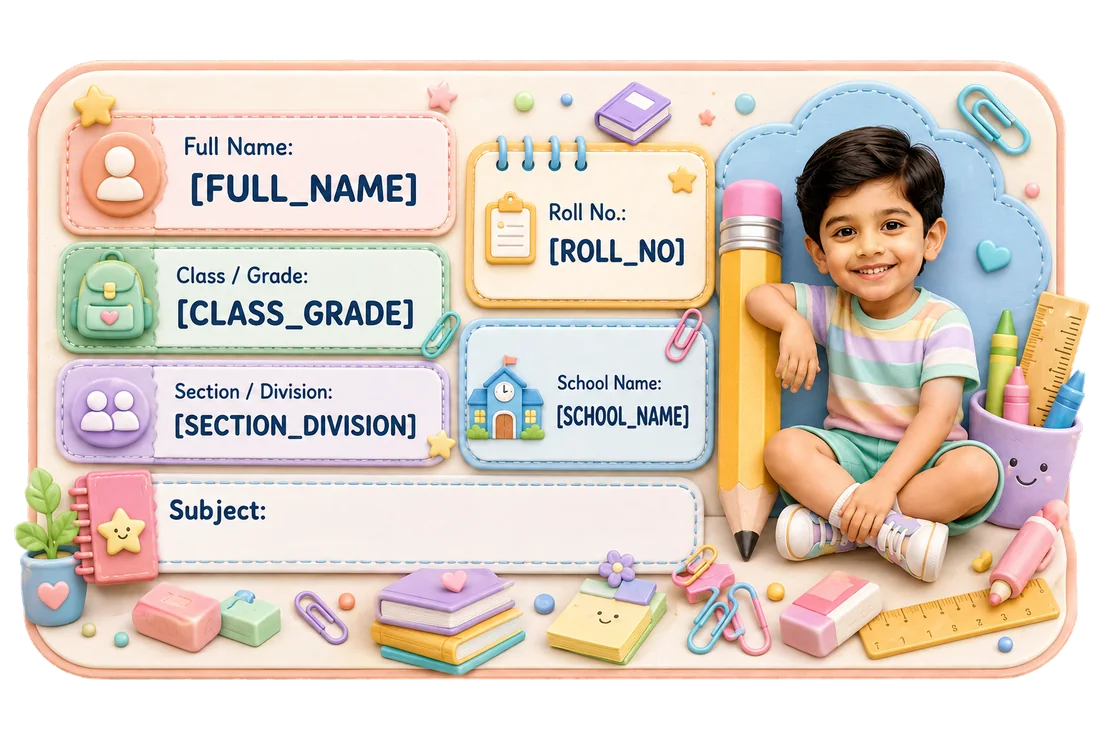
The current Dimple Name Slip page lists a child's name and photo, class or grade, section, roll number and school name. It supplies printed slips in large and small formats, with Subject left blank for completion later.
That product description does not establish support for every language, translated field headings or a bilingual layout. Confirm those requirements through the current form and preview, or contact Dimple before ordering.
A Name Slip preview is also a place to check the child's recognizable face and natural skin tone. Correct spelling and a good portrait are both part of the decision; neither compensates for a problem with the other.
Frequently asked questions
Can I use a Hindi name with English class details?
That can be a useful format where the school accepts it and the product supports it. Verify the exact combination in the current ordering flow and proof.
Will entering a Hindi name translate all the field headings?
Do not assume so. Name entry and heading language are separate features. Confirm the layout before ordering.
What should I do if a character is rejected?
Keep the approved spelling and contact the supplier. Do not replace a mark, letter or punctuation sign simply to bypass the error.
Is copying the text enough to guarantee a correct printed name?
No. Compare the rendered proof too. Missing glyphs, clipping or an altered mark can appear after the text is placed into a design.
Should both scripts appear on every belonging?
Use the school's instructions and the purpose of the item. Add both only where they are useful, accepted and readable in the supported format.